You're about to create your best presentation ever

City Planning Powerpoint Template

Create your presentation by reusing a template from our community or transition your PowerPoint deck into a visually compelling Prezi presentation.

City Template

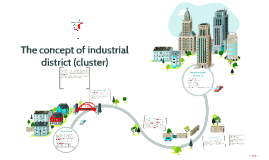
Transcript: Next, Porter revealed that the cluster-based economy capable of encouraging competitiveness in three ways, namely: 1. By increasing the productivity of the industry in the area. 2. By encouraging the creation of new innovations. 3. By encouraging the strengthening of the cluster itself. (Porter, Michael E., Clusters and the New Economics of Competition, Harvard Business Review, 1998). Most references to the origin of industrial districts go back to the economist Alfred Marshall. Marshall expressed his view that when the industry is in a particular geographic region, the handling of the machines and materials will be much easier to do. Marshall also said the positive impact (positive externalities) of industries are concentrated in one area, among others: 1. The existence of knowledge spillover between the existing industries. 2. Input unspecialized of supporting industries. 3. The labor competitiveness (competitive). (Marshall, A, Principles of Economics, 8th ed., 1920). It could be said that the concept introduced by Marshall is closer to the concept of industrial zones or industrial district. Industry cluster consists of: Alfred Marshal The development of the cluster definition starting from a study of the success stories in Northern Italy in the 1980s encouraged the use of terminology industrial district given by Marshall (1920). The definition of cluster is simply a collection of companies sectoral and spatially dominated by one sector. design by Dóri Sirály for Prezi In principle, there are three pillars that are the foundation for cluster-based economy, namely: 1. The geographic area (geographical area). This is a specific area that became the center of activity. 2. Creation of value (value creation). In a cluster composed of various business sectors and industries, each of which create value in the production of goods and / or services they offer. 3. Business environment (business environment). The business environment has a significant influence in shaping the relationship between industry, labor and local government institutions. The existence of the cluster will give more strength to the creation of a competitive business environment. Perspective Michael E. Porter. According to Porter, a cluster-based economy is a concentrated area where there are companies and institutions are interlinked in a particular field. Porter confirms that the keywords in the development of the cluster is the competition (competition). Competition, he said is very dependent on productivity; while productivity lies in the ability of the industry to create products and / or services. Humphrey and Schmitz (1995) The Success of Northern Italy In 1995 the definition of cluster started distinguished from the industrial district, as seen at the time of Humphrey and Schmitz (1995) clarifying the concept of collective efficiency. Cluster is defined as a gathering of the company and sectoral goegrafis. By association, the cluster will benefit from external economies. While the industrial district will arise if the cluster develops more than specialization and division of labor between companies with the advent of the collaboration between the agents of the local economy in the region, and increasing local production capacity and sometimes the innovation capacity also increased (Rabellotti, 1995), as well as the emergence of a strong sectoral associations. Based on the success of the phenomenon of Northern Italy, defined the key characteristics of clusters or industrial districts (Schmitz and Musyck, 1993) as follows: (1) Dominated by small businesses who move in the same sector (specialization in sectors) or sector related; (2) Collaboration between businesses adjacent to the sharing of equipment, information, skilled labor, and so forth; (3) These companies are competing to be based on the quality of the product rather than lowering the cost of production, including wages; (4) Employers and workers have a long history on the site. This facilitates mutual trust in the good relations between small enterprises, between workers and skilled labor; (5) Employers are well organized and actively participate in self-organization; (6) There are local and regional governments are actively supporting the development of local or regional industry cluster. 1. Industrial core 2. Industry Suppliers 3.Buyer / Consumer 4. Supporting Industries 5.Related Industries 6. Organization / Institutional Support The concept of industrial district (cluster)

Editable PowerPoint Template

Transcript: Editable PowerPoint Template Guiding Principles for Effective Presentations Design Principles Introduction to Editable Templates Consistency in Style Color Schemes and Branding Maintaining a consistent style throughout a presentation reinforces the brand image and enhances comprehension. Consistent elements, such as color, fonts, and layouts, help the audience follow the narrative without distractions. A well-chosen color scheme can evoke specific emotions and create a memorable experience. Aligning color choices with branding principles ensures recognition and reinforces your message effectively across all slides. Visual Hierarchy and Layout Definition and Purpose Font Selection and Readability Establishing a clear visual hierarchy guides the viewer's attention to the most critical information. Effective layout techniques, such as balancing text and images, can ensure that key points stand out in your presentation. Overview of PowerPoint Benefits Editable templates are pre-designed formats that allow users to modify content, layout, and design. Their primary purpose is to save time and maintain consistency in presentations across different topics and audiences. Choosing the right fonts is crucial for readability and engagement. Sans-serif fonts are generally preferred in presentations due to their clean lines, while limiting the number of font types maintains visual clarity. PowerPoint simplifies the presentation creation process through intuitive tools and features, such as templates, animations, and multimedia integration. Its widespread use ensures compatibility, making it accessible for diverse audiences. Importance of Editable Formats Examples of Use Cases Editable formats promote collaboration among team members, allowing multiple users to contribute to a single presentation without confusion. They enhance adaptability to specific audience needs, ensuring relevant and impactful communication. Editable templates can be applied in various scenarios, including corporate training sessions, educational lectures, and marketing presentations. They help to tailor content to specific objectives while maintaining a professional appearance. Content Guidelines Structuring Your Narrative Incorporating Data Visualizations Use charts and graphs to represent complex data simply, making it easier for the audience to grasp key points. Ensure visualizations are labeled correctly, providing context to avoid misinterpretation. Organize content logically, beginning with a clear introduction, followed by key points and a strong conclusion. Each section should transition smoothly to maintain audience engagement and ensure key messages are memorable. Effective Use of Text and Images Engaging Your Audience Customization Tips Balance text and visuals to enhance understanding, ensuring that images complement and reinforce the message rather than distract. Limit text on slides to key phrases to promote clearer communication and retention. Use interactive elements such as polls, questions, or discussions to foster audience participation and create a dynamic atmosphere. Understanding your audience and addressing their interests can significantly enhance engagement levels. Adding Multimedia Elements Altering Templates for Your Needs Customize templates to reflect your unique branding and message. Adjust colors, fonts, and layouts to better align with your content's theme and improve audience engagement. Take advantage of template features to create a distinct visual identity. Incorporate videos, audio clips, and animations to create dynamic presentations. Multimedia can significantly enhance the storytelling aspect, making information more compelling and easier to retain for your audience. Saving and Sharing Templates Best Practices for Adaptation After customization, save templates in accessible formats for future use. Use cloud services for easy sharing among team members, ensuring everyone has the most up-to-date version to maintain consistency in presentations. When adapting templates, keep the audience's needs and perceptions in mind. Use feedback to refine designs and ensure your modifications serve the original purpose while enhancing clarity and effectiveness.

Planning Template

Transcript: 3 most important moments in my life wishes and dreams 1.) I want to live on an island in the Pacific with a tribe and study there culture. 2.) I want to have children and get married when I'm older. 3.) I'm a junior in High school but I really want to graduate from College 1.)My mom is one of the greatest influences on my life. Shes taught me so many things that have helped me so far in life. 2.) Snoop dogg taught me to keep it 3hunna all the time . foshizzle 3.) Alexander Supertramp taught me to do what ever makes me happy no matter what people think I should do. Also that you need to get off the grid and live in the most primitive environments to truly find yourself at least once. 3 core beliefs and values 1.) one of my greatest wishes is to travel the whole worldd before I die. I don't want to regret not going somewhere when im laying on my deathbed. 2.) I wish to go bungee jumping in New Zealand with my mom when I get older. 3.) And i dream of one day going to Cochella and see a tupac hologram 1.) I always tell the truth 2.) I try to be kind to everyone no matter how awful a person is. 3.) You just gotta kill'em with kindness 1.) when I was 3 I almost drowned in the Bahamas, but on that same trip i learned how to swim. This is important in my life because I learned a life long skill very early. 2.) When I was 4 I learned how to read and it's helped me tremendously ever since. 3.) The first time i got a job by myself, was very important to me. Planning Template -Jack Hawley My three most important influences 3 Goals for the future

Planning Template

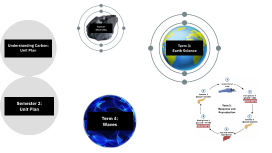
Transcript: Understanding Carbon: Unit Plan Understanding Carbon: Unit Plan To be scientifically literate and informed individuals, students require the knowledge and skills to ask questions, challenge claims and make evidence-based decisions. In this unit, students build on understanding from Year 8 of the model of an atom and describe the role of natural radioactive decay in the creation of stable atoms. They plan and conduct experiments to demonstrate the law of conservation of mass and use word and simple balanced chemical equations to demonstrate this understanding. They rearrange atoms in chemical equations to represent reactions including photosynthesis and cellular respiration. The focus then shifts to exploring the movement of carbon through Earth’s spheres, with students identifying the scientific knowledge needed to interpret data on atmospheric carbon. They explain how peer-reviewed scientific publications contribute to understanding of the carbon cycle. Students analyse data to explain the movement of carbon within and between Earth’s systems. They develop their digital literacy as they acquire, locate and interpret data, building the skills needed for Year 10. Curriculum Curriculum Achievement Standards TERM 1 By the end of Year 9 students explain how body systems provide a coordinated response to stimuli. They describe how the processes of sexual and asexual reproduction enable survival of the species. They explain how interactions within and between Earth’s spheres affect the carbon cycle. They analyse energy conservation in simple systems and apply wave and particle models to describe energy transfer. They explain observable chemical processes in terms of changes in atomic structure, atomic rearrangement and mass. Students explain the role of publication and peer review in the development of scientific knowledge and explain the relationship between science, technologies and engineering. They analyse the different ways in which science and society are interconnected. Students plan and conduct safe, reproducible investigations to test or identify relationships and models. They describe how they have addressed any ethical and intercultural considerations when generating or using primary and secondary data. They select and use equipment to generate and record replicable data with precision. They select and construct appropriate representations to organise, process and summarise data and information. They analyse and connect data and information to identify and explain patterns, trends, relationships and anomalies. They analyse the impact of assumptions and sources of error in methods and evaluate the validity of conclusions and claims. They construct logical arguments based on evidence to support conclusions and evaluate claims. They select and use content, language and text features effectively to achieve their purpose when communicating their ideas, findings and arguments to specific audiences. TERM 2 By the end of Year 9 students explain how body systems provide a coordinated response to stimuli. They describe how the processes of sexual and asexual reproduction enable survival of the species. They explain how interactions within and between Earth’s spheres affect the carbon cycle. They analyse energy conservation in simple systems and apply wave and particle models to describe energy transfer. They explain observable chemical processes in terms of changes in atomic structure, atomic rearrangement and mass. Students explain the role of publication and peer review in the development of scientific knowledge and explain the relationship between science, technologies and engineering. They analyse the different ways in which science and society are interconnected. Students plan and conduct safe, reproducible investigations to test or identify relationships and models. They describe how they have addressed any ethical and intercultural considerations when generating or using primary and secondary data. They select and use equipment to generate and record replicable data with precision. They select and construct appropriate representations to organise, process and summarise data and information. They analyse and connect data and information to identify and explain patterns, trends, relationships and anomalies. They analyse the impact of assumptions and sources of error in methods and evaluate the validity of conclusions and claims. They construct logical arguments based on evidence to support conclusions and evaluate claims. They select and use content, language and text features effectively to achieve their purpose when communicating their ideas, findings and arguments to specific audiences. Content Descriptors SCIENCE UNDERSTANDING represent the carbon cycle and examine how key processes including combustion, photosynthesis and respiration rely on interactions between Earth’s spheres (the geosphere, biosphere, hydrosphere and atmosphere) AC9S9U03 explain how the model of the atom changed following the Rubrics

Planning Powerpoint

Transcript: Bullying/Cyber-bullying Bullying is the act of abuse, discrimination and/or intimidation from one or more persons, to another group or individual. Cyber-bullying is the act of verbal abuse, discrimination and/or intimidation from one party to another, using the internet. Depression Depression is a state of deep sadness and despair. Warning signs include insomnia, decreased energy, frequent sadness, fatigue, social withdrawal, increased irritability, aggression, talk of death, lethargy, crying, loss of interest in pleasureable activites and inability to concentrate. Need 2 Website http://www.need2.ca/is a website that supports and educates viewers on suicide and depression It takes donations to help prevent future suicides. The website helps people get informed about warning signs, clues, danger signs and what you can do to help. Brandon Teena After being raped as a young female child, Brandon went into a slight depression and started to dress, act and introduce himself as a male. He became interested in a sex change. Many years later, his two friends, Tom Nissen and John L. Lotter, found this out, then raped and murdered him. It shows that being harassed can lead to depression and that people discriminate against all kinds of people. Megan Meier Megan Meier killed herself on October 16, 2006 after being harassed on the internet. A middle-aged woman, Lori Drew and her employee created a fake Myspace account of a boy named Josh, who started a relationship online with Megan. They created the account to find out what Megan was saying about Lori's daughter, who had nothing to do with the account. When "Josh" broke up with Megan, she hung herself. Perfect example of cyber-bullying. It shows how much bullying through the internet can affect someone, and can lead to suicide. Facebook Facebook has a wide variety of security features that make it less likely for bullying to occur. New features include things like a "social reporting" tool and a "family safety centre." They can certainly help those in need of it, but it can't stop cyber-bullying 100%. Guidelines If you're using the internet, use it for your own pleasure, not anyone else's pain. Treat everyone on the internet how you would want to be treated on the internet or in person. If someone is cyber-bullying you, make it stop by reporting them. Preventing To prevent bullying and depression we could do things like: Stand up for others being put-down. Stop doing it ourselves. Talk it out. Report it. Seek help.

PowerPoint Presentation Template

Transcript: PowerPoint Presentation Template A Structured Approach for Effective Presentations Project Title Presentation This presentation outlines the project, including key details such as the presenter's name, roll number, registration number, guide, and the department or institution involved. Questions and Engagement We now open the floor for questions. Your insights and inquiries are valuable for deepening our understanding of the project's implications and findings. Significance of the Project Objective of the Project Problem Addressed This project is significant as it addresses [specific problem], which affects [target population or industry]. By tackling this issue, the project aims to contribute to [specific outcome or field]. The primary objective of this project is to analyze the impact of [specific factor] on [specific area]. This analysis aims to provide insights that can inform future decisions and strategies. The problem addressed in this project is [specific problem statement]. Understanding this problem is crucial for developing effective solutions and advancing knowledge in the field of [related field]. Project Overview Acknowledgments Peer Contributions Funding Support Guide's Contribution I appreciate the collaboration and input from my peers which enriched the research process and findings. Gratitude to [Funding Organization Name] for their financial support that made this project possible. Special thanks to my guide, Dr./Prof. [Full Name], for invaluable guidance and support throughout the project. Correlation Between Variables X and Y Research Methodology The primary outcome of this research indicates a significant correlation between the variables X and Y, suggesting that as X increases, Y also tends to increase. This finding could have implications for future studies in this area. Research Contributions and Future Directions The research highlights significant contributions to the field, addressing critical gaps and providing new insights. Future work will focus on expanding these findings and exploring further applications of the results. 25% Improvement in Performance Metrics Key Findings A secondary finding reveals that the intervention applied improved the performance metrics by approximately 25%, highlighting the effectiveness of the approach taken in this research. Notable Differences and Implications Alignments with Existing Literature Challenges in Data Collection The study also identified several key challenges faced during data collection, including participant engagement and data integrity issues, which may impact the validity of the results and should be addressed in future research. However, some differences were noted, particularly in the interpretation of data and the implications drawn. These divergences highlight the unique contributions of this study and suggest areas for further research and exploration. The findings of this research align closely with previous studies, showing similar trends and outcomes, particularly in areas such as methodology and results. This consistency strengthens the validity of the research and contributes to the existing body of knowledge. Data Collection Methods Qualitative Research Approach Analysis Techniques Data was collected through surveys and interviews, ensuring a diverse range of perspectives. Thematic analysis was used to interpret the data, identifying key themes and patterns relevant to the research question. The research employs a qualitative approach to gain in-depth insights into the topic.

Now you can make any subject more engaging and memorable