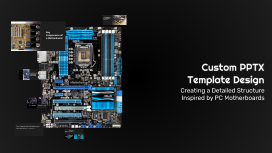
Custom PPTX Template Design
Transcript: Understanding the PC Motherboard Structure The structure of a PC motherboard is vital, comprising various components that play specific roles. Each component varies in size, influencing data organization and system functionality. This presentation outlines these components and their significance in the overall motherboard layout. CPU Socket The CPU socket is the critical interface that connects the central processing unit (CPU) to the motherboard, enabling communication between the CPU and other components. It is designed to accommodate various CPU types, ensuring compatibility with different processors. RAM Slots RAM slots are the locations on the motherboard where memory modules are inserted. The number and size of these slots can vary, directly affecting the amount of RAM that can be installed, which is crucial for system performance. Key Components of a Motherboard Expansion Slots Expansion slots allow for additional components, such as graphics cards and sound cards, to be connected to the motherboard. These slots vary in size and type, providing flexibility for upgrades and enhancements. Power Connectors Power connectors supply electrical power to the motherboard and its components. Proper placement and type of these connectors are essential for stable operation and power management. CPU Socket Size The CPU socket is one of the largest components on the motherboard, typically designed to accommodate various CPU sizes and shapes. Its size highlights the importance of the processor in overall system performance. RAM Slot Dimensions Custom PPTX Template Design RAM slots, though not as large as the CPU socket, are crucial for memory installation. Their size is standardized to fit DIMM (Dual Inline Memory Module) sticks, which vary in height but generally share the same width. Size Ratios of Motherboard Components Expansion Slot Variability Expansion slots, such as PCIe slots, vary in size depending on their intended use, with larger slots designed for high-performance graphics cards, while smaller slots cater to other peripherals. This size variability allows for flexible component placement. Power Connector Sizes Power connectors, which supply electricity to the motherboard, come in different sizes, such as the 24-pin ATX connector and smaller 4 or 8-pin connectors for CPUs. Their size is crucial for ensuring adequate power delivery. Creating a Detailed Structure Inspired by PC Motherboards Power Connectors CPU Socket Area Power connectors are essential for supplying the motherboard and its components with electricity. Their varied sizes and placements optimize power distribution across the motherboard, ensuring stability and performance under load. The CPU socket area is critical for processing power, hosting the central processing unit which is the brain of the computer. Its size is designed to accommodate various CPU models, ensuring efficient data processing and management. Visual Representation of a Motherboard Illustrating the layout and component placement on a motherboard for better understanding of data arrangement. Understanding Motherboard Structure for Effective Data Organization A comprehensive grasp of the motherboard's architecture allows for optimal utilization of space and organization of data in presentations. Each component's unique size and layout inform how information can be effectively structured and conveyed. Component Overview Expansion and Connectivity Power Supply Integration Data Pathways Expansion slots are positioned strategically to allow for additional components like graphics cards and sound cards. The central processing unit (CPU) is situated at the core, surrounded by RAM slots for fast data access. Power connectors are located at the edges to streamline power distribution to all components, crucial for performance. Data pathways are integrated within the motherboard to facilitate communication between components efficiently.

 Prezi Present

 Prezi Video

 Prezi Design