You're about to create your best presentation ever

Healthcare Administration Powerpoint Templates

Create your presentation by reusing a template from our community or transition your PowerPoint deck into a visually compelling Prezi presentation.

Healthcare Administration

Transcript: $3,035 Interviewing Shaun Orr Who practices and where is this practiced in the Upper Valley? What is the required training for this job? $1,735 Utah State University: Business Administration Idaho State University: Healthcare Administration Brigham Young University-Idaho: Healthcare Administration What is the annual salary? Shaun Orr hard at work Where can I obtain a degree in this major? $2,338 Shaun Orr: meetings, schedule, complaints, privacy concerns, new policies, daily operations, committees, finances, audits, hiring Jared Richards: meetings, network, insurances, patients, staff Rachel Gonzalez: meetings, problems, community, network, staff, departments Bachelor’s Degree in Business Management or Healthcare Administration Courses on Business, Economics, Management, Health, Accounting, Communications, and Computers Thanks for watching! With the staff after the job shadow What are the advantages/disadvantages of this career? What is a typical day like? A presentation Shaun gives to people interested in the health center Comparing tuitions of three colleges Natalie Webster Senior Project 2012 Healthcare Administration Shaun Orr – Brigham Young University-Idaho Student Health Center (Rexburg, ID) Jared Richards – Drs. Toenjes, Brizzee, & Orme Cosmetic & Family Dentistry (St. Anthony, ID) Rachel Gonzalez – Madison Memorial Hospital (Rexburg, ID) Dental center or other specialized clinic: Smaller - $35,000, Bigger - $80,000 Typical doctor’s office: Smaller - $50,000, Bigger - $100,000 Hospital: Smaller - $100,000, Bigger - $350,000 Advantages: Job security High paying Building relationships Service opportunities Leadership positions Many career options to choose from Disadvantages: Time consuming Complex Lots of regulation changes What does a healthcare administrator do?

Healthcare Administration

Transcript: The corporate office makes sure that the building and every department in it just like the administrator, is ran smoothly so when State comes in the building they do not receive any citations. Too many citations or major citations can cause a nursing home to close it's doors for good and so corporate,the administrator along with other department heads makes sure that does not happen. Annual State Surveys How many departments are there to over-see? The different departments range from Nursing which is over-seen by the DON as well. The admissions department which controls the census of the builidng. The business office, which controls the monies and insurance mattees of residents. The activities department which keeps the lively hood of the residents functioning. The HR department which handles paperwork matters, check, and insurance for employees, dietary department which does all of the cooking and diet plans for residents, therapy department which helps restore residents back to their prior levels of functioning and the maintenance department which keeps the building functioning and clean. Maitenance also oversees housekeeping and laundry. Even though It may sound like a lot for one person to handle, the administrator actually gets more than enough help from there supervisors and managers. It is not the administrators job to babysit and watch a persons every move. If there are outstanding department heads most of the time the Administrators job is not nearly impossible to do. During the time of the annual survey. Surveyors are qualified to stop any employee at any given time to ask them random questions about nursing home rules and activities and they expect you to know the answer. Why does Corporate need to over-see the administrator? How does the Administrator over-see so many departments? Yes, in fact there are other jobs. It is the administrators responsibility to budget monies and control the expenses that each department may use. Such as the food resources for dietary, Linen for the laundry department, Nursing supplies and properly functioned equipment and those are to name a few. What does the State check for when survey is in progress? Are there any other jobs that the Administrator is responsible for? Having knowledge about the company you work for is always a positive thing and important. Not knowing whats taking place in your building or knowing who to ask questions to can cause you to ineffectively do your job. Everyone has a department head overseeing there job, including the administrator. The title of the department is known as the corporate office. Through out the month the corporate office may visit the nursing home to make sure everything is being properly ran and if any issues may have occurred then they should also have been taken care of in a timely fashion. There should always be a team effort in order for things to run efficiently. However the administrator is responsible for over-seeing all department heads. Why is it important for you to know all of these things about the work place? Who runs the builiding? Healthcare Administration Nursing Home Edition. Does the Administrator Have a Boss? There comes a time once a year when the State comes to the nursing home to do inspections. These inspections are called Annual Surveys. The surveys are subjected to last for a week Monday-Friday from about 7:00 am to 5:00 pm daily.

Healthcare Administration

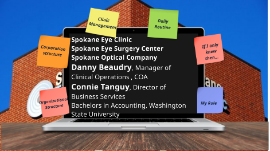
Transcript: Spokane Eye Clinic Spokane Eye Surgery Center Spokane Optical Company Danny Beaudry, Manager of Clinical Operations , COA Connie Tanguy, Director of Business Services Bachelors in Accounting, Washington State University Organizational Structure Organization Structure Chief Executive Officers (CEO, CFO, CIO) Oversee all clinical and non-clinical operations Directors and Supervisors of Administration Manage all non-clinical operations Compliance, finance, accounting, billing, regulations, audit, scheduling, registration, referrals, medical records, human resources, and informatics. Clinical Management Manage all clinical aspects of the organization Physician clinical matters, technicians, diagnostics, patient satisfaction, clinical quality management, and triage. Corporation structure Corporation structure Inland Empire Eye – Parent Company Spokane Eye Clinic Ophthalmology Optometrist Orthoptist Certified Ophthalmic Assistant Ophthalmic Assistant (non certified) Spokane Eye Surgery Center Certified Registered Nurse Anesthetists Registered Nurses Medical Assistant Spokane Optical Clinic Optician Apprenticed Optician Clinic Management Clinical Competencies Team work Customer Service Ethics Organizational support Professionalism Leadership Planning Delegation Adaptability Managing people Add as many notes as you need Daily Routine Email, Email, Email! Daily Rounds Indirect/Direct patient care Day in and Day out Employee interactions Perception Management Physician interactions If I only knew then... Pay attention You will use all of it! Be okay with limited direction Think outside the box - process improvement Document, Document, Document HSAD program classes My Role Annual skills assessment Skill based compensation Orientation 90 day reviews Continuing education Staff Recruitment Equipment repair/maintenance Clinic Manager- North, Education/Orientation

Healthcare Administration

Transcript: The Evolution of Healthcare Administration A chronological overview of significant milestones that shaped healthcare administration as a field. Regulatory compliance complexities Challenges in Healthcare Administration 1960s 1980s 2000s 1900s Financial management hurdles The profession of healthcare management began to take shape, with early administrators focusing on improving efficiency and patient care in hospitals and clinics. The role of hospital administration expanded significantly, with a focus on improving operational processes and patient services amidst growing healthcare needs. The concept of managed care emerged, aiming to control healthcare costs while maintaining quality, leading to the development of new administrative strategies. Technology began to play a pivotal role in healthcare administration, enhancing data management, patient tracking, and operational efficiencies through electronic health records (EHRs). Managing Healthcare Facilities Healthcare administrators are responsible for overseeing the daily operations of healthcare facilities, ensuring that they run efficiently and effectively to provide high-quality care to patients. Shortage of skilled staff Ensuring Compliance with Regulations Rapid technological advancements Compliance with healthcare laws and regulations is critical. Administrators must ensure that their facilities adhere to local, state, and federal regulations to avoid penalties and provide safe patient care. Maintaining patient satisfaction Financial Management and Budgeting Key Responsibilities of Healthcare Administrators Financial management is crucial for the sustainability of healthcare organizations. Administrators handle budgeting, financial planning, and resource allocation to ensure operational viability. Staff Management and Human Resources Effective staff management includes recruiting, training, and retaining healthcare professionals. Administrators are tasked with creating a positive work environment to enhance staff productivity and satisfaction. Strategic Planning and Policy Development Strategic planning involves setting long-term goals and developing policies that align with healthcare trends and organizational missions. This includes adapting to changes in the healthcare landscape. Future Trends in Healthcare Administration Understanding the key trends shaping the future of healthcare delivery and management. 2026-2028 2023-2024 2025-2027 Heightened focus on patient-centered care approaches to enhance satisfaction and engagement. 2024-2026 Integration of AI and data analytics for improved decision-making and operational efficiency. Increased adoption of telehealth services to enhance access to care. Shift towards value-based care models to improve patient outcomes and reduce costs. Conclusion Healthcare administration is a vital component of the healthcare system, ensuring the effective delivery of services and maintaining high standards of care. Its impact is seen in improved patient outcomes, enhanced operational efficiency, and the ability to navigate complex regulatory environments. Introduction to Healthcare Administration Healthcare administration is a vital component of the healthcare system, focusing on the management and organization of healthcare services. Healthcare administrators play a crucial role in ensuring that healthcare facilities operate efficiently, comply with regulations, and deliver high-quality patient care. Healthcare Administration Exploring Strategies and Innovations in Managing Healthcare Systems

Now you can make any subject more engaging and memorable