You're about to create your best presentation ever

Presentation Background And Earth

Create your presentation by reusing one of our great community templates.

earth and life presentation

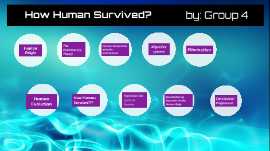
Transcript: by: Group 4 How Human Survived? Human Origin 5 theories on where humans come from We were put on Earth by Aliens- Humans are not from Earth but were put by an aliens Creationism Theory- This theory tells us we were made by God,starting with man and woman, Adam and Eve AQUATIC APE THEORY- The aquatic ape theory can explain how we came to have such features as long hair, protruding noses, and naked skin. Intelligent design theory- a scientific approach to our creation, it claims that there is some sort super natural designer was involved in the creation of the humans Evolution Theory- humans were created through the process of evolution by natural selection Human Evolution -is the evolutionary process that led to to the emergence of anatomically modern humans, beginning with the evolutionary history of apes Sahelanthropus tchadensis (6-7mya) First upright walkers which defines the trait ofthw hominin in eage . Dwells in forest and grassland Orrorin tugenensis (6 mya) can climb trees but were also capable at walking upright and it is about the size at a chimpanzee small teeth and bone buildup of upper femur. Dwells in forest and grassland Ardipithecus kadabba (5.2-5.8 mya) The oldest ancestor that walked upright judging from the large toe that has a broad and robust appearance Dwells in mixed habitat of woodlands and grasslands Ardipithecus ramidus (4.4 mya) A human African ape common ancestor that was not chimpanzee like, in contrast to other hominis before it Dwells in a wooden land and environment Australopithecus anamensis (3.9-4.2 mya) The first human ancestors to live in the savannah, combination of ape and human features. Dwells near the lakes. Australopithecus afarensis (2.95-3.85 mya) one of the best known ancestors due to a number of major discoveries Dwells in woodlands and survived Kenyanthropus platyops (3.2-3.5 mya) claim it's a bridge between the walking apes and modern human Australopithecus africanus (2.1-3.3 mya similar to afarensis with a combination of human-like and ape like features. adapted to both climbing and walking upright Paranthropus aethiopicus (1.2-2.3) The famous "Black Skull" Dwells in a near lake Paranthropus boisei (1.2-2.3 mya) the famous "Zinj skull" indicated large flat cheek teeth and thick enamel Homo habilis (1.4-2.33 mya) known as the"Handy Man " due to the fact that the hominin mastered the lower paleolithic oldowan tool. Homo Rudolfensis (1.8-1.9 mya) was contemporary with homo habilis and the two likely interacted. Dwells near the shores of lake Rodulf Homo ergaster (1.3-1.8 mya) known as the "work man" because for its advanced lithic technology first use "Human voice and protolanguage" Homo erectus (200,000-1.89 mya) " the upright man" as they called capable of controlling fire and tool maker Homo heidelbergensis (200,000-700,000 ya) a sophisticated hunter and tool maker capable of controlling fire and burying their dead. Homo rhodesiensis (125,000-400,000 ya) intermediate features between homo sapiens and homo neanderthalensis Homo neanderthalensis ( 40,000-400,000 ya) our closest extinct relatives Dwells in a cold climate skilled hunters and craftman Homo floresiens (???-50,000 ya) diminutive stature and miniscule brain are the result of island dwarfism known as the "Habit" Homo Sapiens (300,000 years-present) the modern human The Evolutionary Theory humans were created through the process of evolution by natural selection How Humans Survived??? Three different human species may have walked the Earth at the dawn of the human lineage, dividing up their environment in slightly different ways, and the ancestors of modern humans may have survived because off traits such as large brains that helped them adapt to unstable, shifting landscapes, researchers say. Humans Interaction with the environment Reproduction Cycle on Human Human reproduction is any form of sexual reproduction resulting in human fertilization, typically involving sexual intercourse between a man and a woman. During sexual intercourse, the interaction between the male and female reproductive systems results in fertilization of the woman's ovum by the man's sperm. Reproduction Cycle of Human Assisted reproductive technology (ART) Technological Advancements of Human Reproduction In vitro fertilization (IVF) Evidence of Successful of ART AND IVF Digestive system is uniquely designed to turn the food you eat into nutrients,which the body uses for energy, growth and cell. Mouth-digestion starts here as soon as you take the first bite of a meal. Throat-Also called the pharynx, the throat is the next destination for food you've eaten. Esophagus-a muscular tube extending from the pharynx to the stomach. Stomach- holding the food and also mixing and grinding it. Small Intestine-continues the process of breaking down food by using enzymes released by the pancreas and bile from the liver. Pancreas-These enzymes break down protein, fat, and carbohydrates from the food we eat. Liver-make and secrete bile, and to

Background Presentation

Transcript: 14th Week Consulting interns can be expensive Time and Money Personal Experience Preliminary Design Stage NFPA 101 and NFPA 13 New and Existing Education, Business, and Mercantile Definition of Project This app would be used to provide interns and recent graduates with an outline of guidelines for how to design and review designs of specific occupancies. With the given time frame, I will be writing the information that will go into the app Begin parametric study: Speak with my mentor and Jason to understand more about what critical variables I could concentrate on for this app. Choose those parameters and begin my study Gather information from NFPA 101 and NFPA 13 for new and existing education, business, and mercantile occupancies. By: Breanne Thompson Next Steps (Continued) Finish preparing for Draft of Analysis Pull together and discuss results of project Draw my conclusions and state future work needed Turn in Final Paper! 10th and 11th Week Turn in my parametric study Begin draft of analysis Map out the process of the app for the key elements 15th Week References Next Steps 7th Week Prepare for Final Presentation Summarize my draft of analysis into presentation Work on how to incorporate a live demonstration for my presentation App Development Background Information 8th-9th Week Continuous Process Objective-C for Apple products Java for Android products 6 months of studying Places to Learn: Codecademy, iOS Dev Center, Android Developers Training Hire App Developer will cost thousands Prepare Final Paper Dive into Shark Tank! 1. http://lifehacker.com/5401954/programmer-101-teach-yourself-how-to-code 2. http://www.bluecloudsolutions.com/blog/cost-develop-app/ 6th Week Background Presentation 12th-13th Week

Presentation Earth and Climate

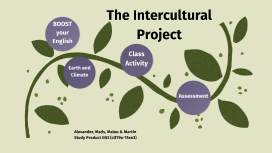
Transcript: The Intercultural Project Alexander, Mads, Malou & Martin Study Product EN3 (clf19o-11en3) BOOST your English https://i-bog.gyldendal.dk/boost_5_ny_udgave/#/?page=1 Earth and Climate Earth and Climate Language acquisition Intercultural awareness Authentic communication Exchange of legitimate views Education in sustainability Introduction to Earth and Climate Play button for intro video Introduction Lesson plan Class Activity Earth and Climate Vygotsky’s sociocultural perspective: Language development is a result of interactions “It is important for the intercultural project that culture is the very core of language teaching” (Rose, 2003) working with language as an activity where the target language is used by the learner for a communicative purpose in order to achieve an outcome (Willis & Willis, 2001) Your Intercultural Activity! Sweden has Greta Thunberg Intercultural Activity Ireland has Flossie Donnelly But who do we have in Denmark? Discuss the answer with your neighbour and upload your suggestion Give atleast three reasons why BTW you ONLY have 2 Minutes Upload Assessment Assessment Assessment slide 4 attitudes and skills defined by Rose (2003): 1. observing, identifying and recognizing 2. comparing and contrasting 3. negotiating meaning 4. accepting difference Formative assessment Signs of learning Interkulturel kontakt: ”Eleven kan give eksempler på forskelle og ligheder mellem kultur og samfundsforhold i eget land og i engelsksprogede områder.” (Fællesmål 2019) ”Eleven har viden om enkle kultur og samfundsforhold i engelsksprogede områder. ” (Fællesmål 2019) Lytning: ”Eleven kan forstå hovedindholdet i lette fagtekster”. ”Eleven har viden om anvendelse af baggrundsviden”. ”Eleven kan forstå enkle, letforståelige tekster i naturligt taletempo.” (Fællesmål 2019) Samtale: ”Eleven kan udveksle enkle, forberedte informationer om faktuelle emner”. ”Eleven kan indgå i en enkel, spontan samtale om kendte emner”. ”Eleven kan udveksle synspunkter om kendte emner og situationer”. (Fællesmål 2019) Signs https://padlet.com/laer185285/pq8nzkynmce6j72f

Background Presentation

Transcript: Real action and accountability Amnesty International Non-state actors/ Rebel Groups?? ...and what about men?? ignoring male rape victims? would rape exist without a man? Weapons of War: Rape UN as an Arena - NGO's - Discussion and dialogue Arena Instrument Actor Critical Thinking Weapons of War: Rape UN as an instrument UNSC Resolution 1820 (2008) UN as an Actor - UN Action Against Sexual Violence in Conflict Weapons of War: Rape Problems with 1820 "Roles and Functions of International Organizations" "Sexual violence, when used as a tactic of war in order to deliberately target civilians or as a part of a widespread or systematic attack against civilian populations, can significantly exacerbate situations of armed conflict and may impede the restoration of international peace and security… effective steps to prevent and respond to such acts of sexual violence can significantly contribute to the maintenance of international peace and security" (UNSC Resolution 1820, p. 2)" http://www.stoprapenow.org/uploads/advocacyresources/1282164625.pdf Background Presentation- Kristin Mann Weapons of War: Rape Brief Insight - used to manipulate social control - destabilize communities - weaken ethnic groups and identities Examples: - Sudanese Militia - Rwanda Genocide - DRC Critical Thinking http://www.womenundersiegeproject.org/blog/entry/the-need-for-numbers-on-rape-in-warand-why-theyre-nearly-impossible-to-get Critical Thinking Increased Data Collection by international organizations - determine humanitarian responses - ensures justice and reparation - provides recognition and dignity

Earth and Space presentation

Transcript: Sensors are those parts of larger systems which gather information about the world, make sense of it and then communicate that information Sensors are constantly developing and improving and will be used in many future projects and missions, for example: Europa Jupiter System Mission -Launched in 2020 -NASA and ESA -Will explore the emergence of habitable worlds around the gas giant planets -The mission focuses on the Galilean moons Europa and Ganymede, but also investigates Io, Callisto, and the Jupiter system as a whole How it would work: Orbiters would enable science investigations, using their science instruments and will: -search for the presence and extent of subsurface oceans -characterize ice shells & subsurface water -compare exospheres, plasma environments, and magnetospheric interactions By:Katie and Yanming Without the development of new sensory technology, NASA's exploration would not proceed These sensory instruments are vital in order to: -collect and process scientific data -to answer compelling questions -to provide crucial knowledge (enable robotic missions) -many of these technologies are also used to support human missions (test safety environment) *mars article -ice-penetrating radar -visible–infrared spectrometer - ultraviolet spectrometer -ion and neutral mass spectrometer -magnetometer Passive Sensors- -Detect natural energy (radiation) that is emitted or refllected by the object/scene being observed -Most common source of radiation reflected is sunlight -Most operate in visible, infared, thermal infared and microwave portion of the electromagnetic spectrum Ex1. Magnetometer- an instrument used for measuring magnetic forces Ex2. Spectrometer- device designed to detect, analyze, and measure spectral content of incident electromagnetic radiation Active Sensors- -Provide own source of energy (radiation) to illuminate the objects they observe -Most operate in microwave portion of electromagnetic spectrum Ex. Radar- radio detection and ranging sensor that emits microwave radiation in pulses out of antenna, when the energy reaches the target some in reflected back; the time it took to travel back determines the range and distance of the object Sensory Technology Used in Europa Jupiter System Mission The cost of sensory technologies can range anywhere from a few hundred million to even billions Ex. A space-based instrument is being built to monitor major air pollutants across the North American continent hourly during the daytime The instrument, to be completed in 2017 at a cost of $90 million, will ride on a commercial satellite that orbits about 22,000 miles above Earth's equator. Types of Sensors Future Projects Technology developments will help study the themes of: Weather, surface and interior, carbon cycles, ecosystems; water and energy cycles, climate variability and change, and atmospheric composition Cost of Sensory Technology Sensory Technologies Future Sensory Technologies Importance of Sensory Technologies

Earth and Water presentation

Transcript: Ground and Water Created by CALVIN MAI GROUND EARTH Ground Factsz The ground is where a most animals that have to breathe air live, some types of animals that live on the ground are are: Most Mammals, Some reptiles, Maybe Amphibians, some insects, and arthropods. Ground is the first solid layer of earth it is solid because if it wasn’t most things will collapse through the ground and everything we could've built would be below the ground not above like right now. Ground can actually run out but i think that's is going to take a very long while. Ground Facts Fun Facts The Ground is the thing that seperates us from ores of gold or dimond ang the ground also helps us with buildin because ground goes realy deep into the Earth Ground Fun Fact Somthing that Ground and water have in common that has been written down The thing water and ground have in common is that they all have at least 1 Mammal, Reptile, Amphibian and Insect on The Ground or under Water Sonthing both water/earth have in common if you see this then your in deep SHIT Alert Sequence Water Facts Water will never run out because water can only change form so that if you spill water on the ground it evaporates and rains down water. To clean water you basically just boil it until all the water has evaporated onto the lid and it all fell back into the pot then you just renewed water. To clean water you basically just boil it until all the water has evaporated onto the lid and it all fell back into the pot then you just renewed water. Water Facts Fun Facts Nearly 97% of the world's water is salty and that means 3% of the earths water is proven drinkable. Water Fun Fact Water WATER O

Now you can make any subject more engaging and memorable