You're about to create your best presentation ever

Jefferson Presentation Template

Create your presentation by reusing one of our great community templates.

Jefferson Presentation

Transcript: Thomas Jefferson's Life Early Life Early Life Childhood Childhood Born on April 13, 1743, in Shadwell, VA. Raised by his father, a successful planter, and his mother, who came from a respected Virginia family. Grew up with six sisters and a brother, and he was the eldest son in the family. (2) Education Education He studied mathematics and political philosophy and later graduated from the College of William and Mary in Williamsburg, Virginia, in 1762. He went on to study law while in a tutelage under George Wyhte, the former Attorney General of Virginia. (3) Adulthood Adulthood "Jefferson began working as a lawyer in 1767, and was appointed as a member of colonial Virginia’s House of Burgesses from 1769 to 1775." (3) In 1784, Jefferson went to Paris with John Adams and Benjamin Franklin to discuss commercial agreements with European powers. (3) Jefferson married Martha Wayles Skelton, a young widow on January 1, 1772 and later had 6 children. (2) When Martha died, Jefferson was very upset but it was believed that he had two more children later on with her sister. (2) Revolutionary Era Revolutionary Era Thomas Jefferson was selected to be a part of the Second Continental Congress during the Revolutionary War. (2) He later collaborated with John Adams and Benjamin Franklin while writing the inital draft of the Declaration of Independence, detailing the colonists' list of reason why they wanted freedom from Great Britain. (2) Jefferson later resigned from the Continental Congress in 1776 and instead was re-elected to the House of Burgesses, where he made history by authoring the Virginia Statue for Religious Freedoms. (2) Virginia lawmakers later passed the law in 1786, "It was a forerunner to the First Amendment to the U.S. Constitution, which protects people’s right to worship as they choose" (2) The first amendment harbored freedom of speech and the right to worship freely. Presidency World War II, also known as the Second World War, was a global war that lasted Presidency George Washington appointed Jefferson as the first secretary of state of the newly-formed nation in 1789. (2) During this time, Jefferson began to have disagreements with Hamilton over foreign affairs, as well as the fact that they had contrasting expositions pertaining to the Constitution. (2) In the presidential election of 1796, Thomas Jefferson ran against John Adams, earning the second-highest amount of votes, which granted him the vice-president spot. (1) He later ran against Adams again in 1800 and won. (1) Impact Impact Jefferson, a talented author, was assigned to write the Declaration of Independence when he was 33 years old. He was considered a "silent member" of Congress. In the years that followed, he put a lot of effort into making his words a reality in Virginia. Most notably, he drafted a law that guaranteed religious freedom in 1786. Thomas Jefferson formulated and upheld the American ideals of press freedom, freedom of speech, and freedom of conscience. (2)

Jefferson Presentation

Transcript: Thomas Jefferson Memorial Thomas Jefferson's ideas and beliefs were the foundation to the structure of our government today. Life Stats Through 1784 to 1789 Thomas Jefferson succeeded Benjamin Franklin as a Minister to France, and witnessed the downfall of the French evolution. Thomas Jefferson's Role in American Revolution -served Continental Congress -served as a legislator for Virginia and as a secretary of state Who Was Jefferson? The man who gave birth to the nascent (new) nation still searching for its name... Why Did Thomas Jefferson Deserve a Monument? President Franklin Roosevelt believed that a person of such magnitude deserved a memorial. -1943 Roosevelt asked commissions of Fine Arts about the possibility of erecting memorial of Jefferson The Memorial After Congress approved 3 million dollars for the memorial a design by John Russell Pope was chosen for the memorial in 1936. Jefferson's importance demanded the memorial site to be a place of prominence in the Capitol City, equal to the Washington Monument and Lincoln Memorial. The placement of the memorial is in Tidal Basin, a man made inlet. Dedication of this memorial was on April 13, 1943, the 200th anniversary of Thomas Jefferson's birth. The memorial stands at 129ft with a dome thickness of 4ft. Design of the Monument Adorning the interior of the memorial are five quotations taken from Jefferson's writting to illustarte the way he dedicated himself to living his life. Monument Intention The intent of the monument was to integrate Thomas Jefferson's contribution as an architect, President, statesman, drafter of the Declaration of Independence, advisor of the Constitution, and founder of the University of Virginia, among other things. The Japanese cherry trees outside of the memorial were presented as a gift from Toyo, Japanto, to the City of Washington, DC in 1912. On the triangular pendant featured on the statue, is Adolph Weinman's portrait of the five members of the Declaration of Independance drafting committee, submitting in a report to congress. Thomas Jefferson died on the 50th anniversary of the Declaration of Independance in 1826; just a few hours before John Adams died, that same day. American Identity This memorial has a great importance to the American Identity because it symbolizes all that Thomas Jefferson did for his country and how he helped shape it. Without the memorial, the concept of how important Jefferson’s contributions were would not be fully grasped. Jefferson is part of our history; without the Louisiana Purchase America would be smaller. The new land helped extend America’s economic independence. His beliefs contributed to some of America’s freedoms. For example, the United States practices separation of church and state; the country maintains a balance of power between the federal government and states rights; and Jefferson’s ideals made education available to all. -freedom of religion, with seperation of church and state -barely escaped capture by British in 1781 -democracy The bronze statue of Thomas Jeferson, sculpted by Rudolph Evans stands 19ft tall and weighs five tons. It was first created out of plaster because metal was being rationed for WWII. After it was replaced with the bronze replica. Vice President under John Adams from 1797 till 1801. -supported state rights -opposed Alien and Sedition Acts 1779-1781 War time Governor of Virginia -sponsored Lewis and Clark expedition to mouth of Columbia River Thomas Jefferson was also a politician, architect, writer, musician, scientist, and inventor Born- April 13, 1743 at Shadwell hospital in Albemarle County, Virginia Roman Pantheon -equal rights -education aviable to all -negotiated Louisiana Purchase The outside of the memorial is created out of Vermont marble. Inside the memorials walls are lined with white Georgia marble. The statue rests on Minnesota marble surrounded by pink marble from Tennessee. The monument was designed after the Roman Pantheon because Jefferson was the one to introduce this classic style into America. John Russel Pope opted for a neoclassical dome and portico base due to Jefferson's support of this classic Greek architecture Jefferson Memorial THE END Cool Facts 1801 to 1809 Jefferson was president A firm beleiver in:

Presentation Template

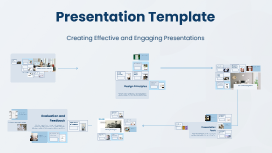
Transcript: Assets Presentation Template Creating Effective and Engaging Presentations Comment Color Schemes Color schemes impact perception and engagement. Utilizing complementary colors enhances readability and evokes emotional responses, while a consistent palette promotes professionalism and cohesiveness throughout the presentation. Why Are Presentations Important? Key Elements of a Good Presentation An effective presentation consists of clear objectives, engaging content, appealing visuals, and strong delivery. These elements work together to ensure the message is understood and retained by the audience. Presentations are a vital tool for conveying ideas and information in a concise manner. They help engage audiences, facilitate knowledge sharing, and support decision-making in various contexts, from business to education. Font Selection Storytelling Techniques Common Presentation Formats Using Data and Statistics Crafting a Compelling Conclusion Choosing the right fonts ensures readability and visual appeal. Sans-serif fonts are generally preferred for digital presentations, while contrasting font styles for headings and body text can enhance clarity. Introduction to Presentations Presentations can take various formats, including slideshows, verbal talks, and interactive workshops. Each format serves specific purposes and can be chosen based on the audience's needs and the presenter's objectives. A strong conclusion summarizes key takeaways and reinforces the significance of your message. Present a call to action, encouraging the audience to reflect or act upon the information, leaving a lasting impression. Understanding the essential features of effective presentations is crucial for successful communication. This section covers the importance of presentations, the key elements that make them effective, and how to tailor your message to your audience. Storytelling in presentations makes content relatable. Use personal anecdotes or case studies to illustrate points, weaving emotional connections that resonate with your audience and aid in memory retention of key messages. Incorporating relevant data strengthens your arguments and adds credibility. Utilize visuals like charts and graphs to present complex information clearly, ensuring that statistics are contextualized and connected directly to your overall narrative. Understanding Your Audience Setting Clear Objectives Visual Hierarchy Image Usage Creating Engaging Headlines Knowing your audience is crucial for tailoring your message effectively. Factors such as demographics, interests, and expertise level should inform the presentation's content and style for maximum impact. Defining clear objectives is essential for any presentation. Objectives guide the content and keep both the presenter and audience focused on the intended outcomes, ensuring effective communication. Visual hierarchy prioritizes information to guide the audience's focus. By varying font size, weight, and color, key points are emphasized, allowing for quicker understanding of the presented material. Images should complement the content, not overwhelm it. High-quality visuals can illustrate complex ideas, but maintaining relevance and context is crucial for impactful communication. Headlines serve as hooks to capture your audience’s interest. Craft headlines that are concise yet compelling, leveraging impactful words to convey the essence of each section, encouraging further engagement with the content that follows. Layout and Spacing Structuring Your Presentation Content Development Effective layout and spacing guide the audience's eye. Proper alignment and ample white space can enhance readability, prevent overcrowding, and create a more polished, professional appearance. A well-structured presentation enhances clarity and retention. Consider using a clear beginning, middle, and end, supplemented with transitions that guide the audience through your key points. Utilize frameworks like the Problem-Solution or Chronological approach depending on your topic. Effective content development is the backbone of any successful presentation. It involves careful structuring and engaging communication to ensure your message is understood and retained. Design Principles Effective design principles are fundamental for creating engaging presentations that hold the audience's attention. Understanding visual hierarchy, color schemes, font selection, image usage, and layout ensure that messages are conveyed clearly and professionally. Managing Nervousness Learning from Past Presentations Nervousness is common among presenters; techniques such as deep breathing, visualization, and practice can effectively manage it. Creating a clear structure for the presentation can also boost confidence and promote calmness during delivery. Incorporating Multimedia Reviewing recordings of past presentations can illuminate patterns in performance. This reflection enhances understanding of effective techniques and common

Jefferson Presentation

Transcript: The innocence of Jefferson "Nobody wishes more than I do, to see such proofs as you exhibit, that nature has given to our black brethern, talents equal to those of the other colors of men..." (Benjamin Banneker letter) Evidence #1 Evidence #1 "Through out his entire life, Thomas Jefferson was a consitent opponent that slavery presented the greatest threat to the survival of the new American nation. Jefferson also thought that slavery was contrary to the laws of nature, which decreed that everyone had a right to personal liberty." (Christa Dierksheide, 2008) Evidence #2 Evidence #2 Evidence #3 Evidence #3 "Jefferson's belief in the necessity of ending slavery never changed (from the mid-1770s until his death) same plan of gradual emancipation." WIth the help of these articles we can clearly see that even though he did say that all men are created equal, he isn't guilty for not including our black brothers since at the time they weren't considered humans but rather property. Even if he had become president and tried to abolish slavery since he didn't like it, many people would revolt since it wouldn't be for a life or death situation. Reasoning Reasoning With the overall evidence and information that goes along with it, it has been proven that Thomas Jefferson was indeed a innocent man. Conculsion Conculsion Additional information Additional information "the future was the screen upon which Jefferson projected his faith in the unfolding of the human potential under conditions of freedom"( The Mind Of Thomas Jefferson pg.8)

Now you can make any subject more engaging and memorable