Optional Multimedia Project - MIT SLOAN
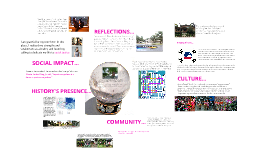
Transcript: As a Korean-American woman, I feel privileged to have such intimate access points to many different cultures. While at times it has been difficult to navigate my own space in the world, I appreciate my heightened awareness of the power of rituals and the value of suspending judgments on other cultures, both within the United States and across the world. I am grateful for my time here. In this place, I realized my strengths and weaknesses as a leader, and found my calling to dedicate my life to social justice. I would pet my cats, thinking about how the only difference between them and the strays outside is luck. I would think about my privilege, and about how every human life is a combination of hard-work and chance. And I worked my hardest for my students. …as well as blight and poverty in glaring juxtaposition (and yes, this is all the same street). COMMUNITY... Spanish Town is a mix of restored historic homes and mansions... Why a pink flamingo? Apparently, it is because “poor taste is better than no taste at all!” Since moving to Louisiana, I have gained access to the Black community through teaching, the slam poetry community through coaching, and the thought-leader community through “Group of 10” discussion groups. HISTORY'S PRESENCE... Louisiana's culture is both a melting pot and so distinctly its own. On each side of town, people enjoy boudin and boiled crawfish. Having worked intimately on both sides, I see that they have more in common than they realize; that most other people in the country have no idea what boudin is (it's a sausage made with meat, rice, and seasonings). Spanish Town was established in 1805, not long after the 1803 Louisiana Purchase. But Baton Rouge was not part of the Purchase and remained under Spanish rule until Anglo settlers rebelled in 1810. Today, Spanish Town is a liberal enclave, adjacent to downtown Baton Rouge and the Capitol. It straddles the line between North and South Baton Rouge, between poverty and wealth, between black and white. REFLECTIONS... Spanish Town’s Mardi Gras Parade tends to take on more “tongue-in-cheek” themes. Residents, neighbors and friends don pink and catch beads with pendants of flamingos drinking beer. This is an integral part of building Spanish Town's unique culture, but what’s more, people from North and South Baton Rouge come together and wash away racial divides if only for one day. To give you a sense of how important community, culture, and social justice are to me, and what I might bring to the Sloan community, I'd like to take you on a tour of Spanish Town: my neighborhood in Baton Rouge, Louisiana. For many reasons, I consider Spanish Town to be a microcosm of our nation: where history coexists with the present in divisive and harmonious ways. This is my home and refuge, an arts and crafts bungalow from the early 20th century; this is the place where I came to reflect on the world and my place in it. SOCIAL IMPACT... I cannot know what I know and not feel compelled to act. Martin Luther King, Jr. said, “Injustice anywhere is a threat to justice everywhere.” After Baton Rouge became part of the United States in 1810, a group of Canary Island settlers, who had enjoyed Spanish rule, moved to Spanish Town to maintain their identity and community. Recent residents adopted the pink flamingo mascot to signal difference and community. Due to the cultural Catholicism in Cajun-Creole Louisiana, Mardi Gras (French for “Fat Tuesday”) is the last hurrah before Lent begins on Ash Wednesday, and each community celebrates Mardi Gras in its own way. I came here to do Teach For America. Each morning, I woke up at 5:30 a.m. to drive into North Baton Rouge to Istrouma High School. I would return at 5:30 p.m. to Spanish Town and reflect on how my students would come home each day to such different circumstances and neighborhoods. The experience was humbling; their challenges made my problems seem small. CULTURE... Bringing it home...

 Prezi Present

 Prezi Video

 Prezi Design